



Why Whisky Casks are a Better Investment than Bottles
Key takeaways
- The benefit of casks over bottles is that an investor is buying a still-maturing asset, which can potentially appreciate, rather than a bottle that has already been matured and won’t change further.
- Bottle investors are backing scarcity and reputation in a single, fixed product, so returns depend heavily on finding the right bottle at the right price and timing the sale well rather than on the whisky itself continuing to develop and gain value while it's held.
The whisky bottle market relies on investors finding unique or limited-edition expressions at a reasonable price. The cask market is different. It’s easier to invest and is more straightforward. It provides investors with ownership of a maturing physical asset, rather than a finished bottle, with a value that depends mainly on scarcity, provenance and demand from the secondary market.
This article explains how whisky bottle investing compares to whisky cask investing. We look at how they may generate returns, why they attract investors, and why, in some cases, casks might be a more appealing prospect.
Firstly - some definitions
What is whisky bottle investing?
Whisky bottle investing is buying individual bottles of whisky, usually rare, limited edition or from closed distilleries, with the aim of selling them on for a profit later. It's the more visible side of whisky investment: the six-figure auction results for names like Macallan or Karuizawa get the headlines, and it appeals to people who want something tangible and collectable to hold onto in the meantime.
What is Whisky Cask Investment?
Whisky cask investing is buying a cask of maturing Scotch whisky, usually while it's still aging in a bonded warehouse, with the aim of selling it on once it's matured further or reached a specific age.
Related reading: When is the best time to sell a whisky cask?
Unlike a bottle, a cask is a single, wholesale asset: its value comes from the spirit inside continuing to develop and become scarcer as it matures, plus the wider trends in the whisky market, rather than from hunting down a specific rare release at the right price.
Why Is Whisky Investment Different Between Casks and Bottles?
When people think about investing in whisky, they often think about the finished product. They see the eye-watering prices rare whisky bottles command at auction. That’s no surprise. In recent years, we’ve witnessed whiskies sell for astronomical sums. In February 2020, a bottle of 60-year-old 1926 Macallan sold for a hammer price of US$1 million.
Cask and bottle investment share the same starting point, Scotch whisky as an asset, but the mechanics of owning each are quite different, and that shapes how each one performs as an investment. It starts with how whisky is produced.
There are three principal ingredients in whisky: water, yeast and barley. But there is something else that you need to make whisky: time.
A cask of whisky lives and breathes. The porous oak allows air in and out of the cask. The interaction gently moves the whisky as it interacts with the wood and matures in flavour.
When you invest in a cask, you buy the whisky whilst this maturation is happening. You don’t just buy one bottle with a label.
You get a cask full of whisky while it’s aging. One cask might yield between 200 and 300 bottles. And because the cask improves a whisky’s taste over time, the longer it’s in the cask, the more valuable it might become.
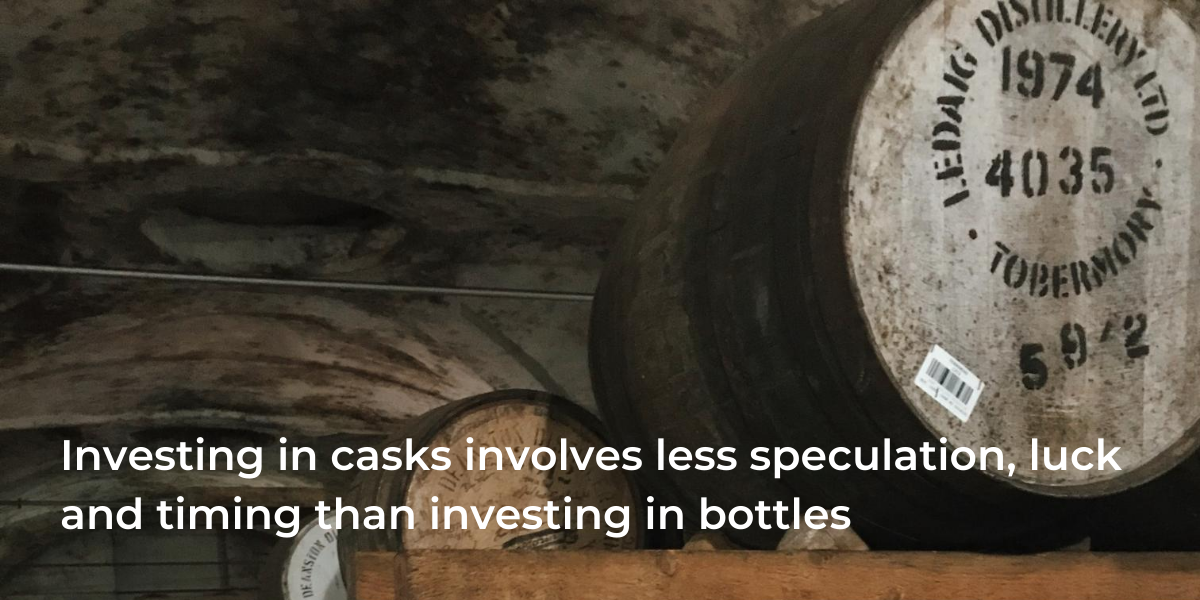
Investing in casks involves less speculation, luck and timing than investing in bottles. It is a straightforward asset that can potentially appreciate over time.
With a bottle, you're buying a finished, fixed product. Its condition won't change, and its value depends almost entirely on scarcity, provenance and demand for that exact release. That means success comes down to sourcing well. Finding the right bottle, from the right distillery or bottler, at a price that leaves room for it to appreciate, then waiting for the right buyer to want it as much as you do.
Rare whisky bottles can definitely be valuable, and although the 1926 Macallan we’ve mentioned is an extreme example, it shows how collector demand can create extraordinary prices.
The bottle market does, though, depend on lots of factors, with some comparisons as follows.
A Comparison of Whisky Cask Investment and bottle Investment
|
Factor |
Whisky Cask |
Bottled Whisky |
|
Continues to mature |
Yes |
No |
|
Physical asset |
Yes |
Yes |
|
Indicators of value |
Distillery, age, cask, provenance and demand |
Brand, rarity, condition, provenance and demand |
|
Storage |
Usually professional bonded storage |
Specialist bottle storage is recommended |
|
Potential exit plan |
Sell, bottle, keep or transfer |
Usually keep or sell |
|
Long-term commitment |
Usually at least several years |
Varies considerably |
|
Bottling costs |
Applicable if the owner decides to bottle |
Already bottled |
|
Duty/VAT considerations |
Suspended while the cask remains in bond |
Already relevant to the finished product |
The important aspect is that cask and bottle investment are two different considerations, rather than being different options within the same investment strategy.
Spiritfilled says, ‘We believe that the best cask investments should combine careful selection of quality casks with professional storage, transparent ownership documentation and realistic expectations about returns.
So which is better for investment? Whisky Bottles Or Whisky Casks
Our experience as a whisky cask investment specialist and independent bottler gives us insights about what might make a cask attractive beyond its initial purchase price, and the key question is whether a maturing whisky is better suited to your objectives than a finished bottle.
“For investors who want a tangible, long-term asset with the option to continue maturation or eventually bottle or sell, cask ownership might be ideal. Those who are more focused on rarity, provenance and finished products might find that bottles make more sense.”
Frequently Asked Questions
Why Do Whisky Casks Continue Maturing?
One of the important distinctions between these two potential investments is that once whisky has been bottled, the liquid isn’t interacting with the oak anymore. Properly stored bottles can, of course, preserve their contents, but the whisky isn’t maturing.
Cask whisky engages with the wood, with compounds that influence its colour, aroma and flavour, although exact outcomes will depend on variables such as:
- The type of oak
- What the cask previously held
- The cask size
- The distillery and character of the spirit
- Maturation durations
- Warehouse conditions
This is why two casks from the exact same distillery might develop differently, because the cask itself is part of the maturation process, rather than simply being a container.
Is a Whisky Cask Investment More Flexible Than a Bottle?
Possibly, because owners of casks have several potential options. A bottle is in its final form, and owning a bottle means the primary exit strategy is to sell it. In contrast, cask owners might:
- Continue to let the whisky mature
- Sell the cask as-is
- Bottle the whisky
- Gift or transfer the cask
- Retain it as a legacy asset
This doesn’t mean every outcome will produce the same financial result, because, for example, bottling introduces costs such as duty, VAT, packaging and professional bottling fees. However, it does mean an owner isn’t restricted to one route from the moment the cask is purchased.
Does Whisky Cask Investment Involve Risks?
Yes, because all investments have the potential to make a loss, as well as a return, and although casks often appreciate over time, this isn’t guaranteed. Investors making financial decisions should think about:
- Illiquidity, and how fast they might be able to sell
- Market risk with changes to demand and valuations
- Storage costs, including management and insurance
- Evaporation as the whisky gradually reduces owing to the angel’s share
- Regulatory considerations, given the lack of regulation in the UK market
- Bottling costs, including duty, VAT and production costs
- Capital risks, because there is no guarantee an investor will receive more than they paid
The realities of investment mean proper due diligence and a well-thought-out exit strategy are essential, regardless of whether you choose to invest in a whisky cask or bottle.
You can read more about the risks of whisky investment here.
Frequently Asked Questions
Is Investing in Whisky Casks Safer Than Buying Bottles?
Not necessarily, no, because either option has risks. Market risk is inherent, and there is always a possibility that an asset might not achieve an anticipated resale value. Cask investments also involve long-term storage and liquidity considerations.
Do Whisky Casks Increase in Value as They Get Older?
Often, yes, but not automatically. Maturation can mean scarcity increases, and that the character of the whisky improves. However, value also depends on the cask type, distillery, provenance and market demand.
How Many Bottles Can You Get From a Whisky Cask?
This depends on the original cask size, natural evaporation, the remaining volume, ABV and how you decide to bottle. The best option is to organise a professional regauge, which will provide a much more reliable estimate than assuming the cask’s original capacity will remain.
Fees and T&Cs apply. Cask investments can go down as well as up. Past performance and forecasts are not a reliable indicator of future results. Cask investments are unregulated in the UK. Capital at risk.
